What types of self-cleaning filters are there?
The self-cleaning filter technology is highly mature, resulting in various types named after different cleaning mechanisms to meet diverse and complex operating conditions, from coarse to fine filtration.
Below are the mainstream self-cleaning filter types and their detailed explanations. You can choose based on working principle, applicable scenarios, and characteristics.
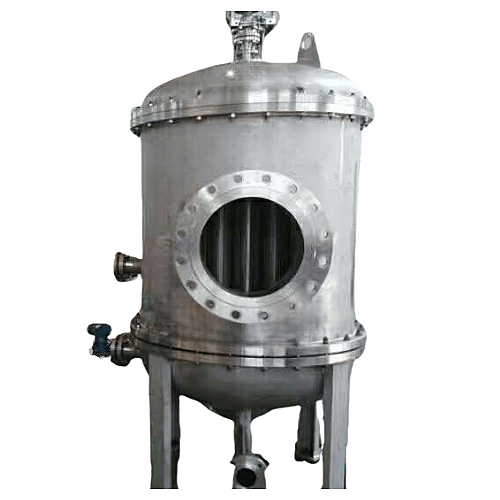
I. Classification by Core Cleaning Mechanism (The most common classification method)
1. Brush/Scraper Self-Cleaning Filter
Working Principle: During filtration, water flows through an internal wedge-shaped filter screen or perforated filter cartridge. When the pressure differential reaches a set value, a drive motor rotates an axial brush or scraper, scraping away impurities adhering to the inner surface of the filter screen, which are then discharged through a drain valve.
Core Features:
- Physical scraping, strong cleaning power.
- The filter screen is mostly made of single-layer high-strength stainless steel, with a robust structure.
2. Backwash Self-Cleaning Filter
Working Principle: This is the most classic and reliable type. The filter contains multiple filter elements (such as wedge-shaped wire filter cartridges or sintered mesh filter cartridges). When the pressure differential increases, one or more filter elements are isolated into the "cleaning chamber" via a hydraulically driven device (such as a rotating arm). Using the system's own pressure or external pressurization, the cleaning fluid is forced to flow backward through the filter elements, flushing impurities off the filter element surface and removing them.
Key Features:
- Hydraulic backwashing.
- Typically a multi-cartridge structure, with alternating cleaning cycles to ensure continuous water output.
3. Scraper/Disc Self-Cleaning Filter
Working Principle: The filter unit is a set of tightly stacked grooved plastic or metal discs. During filtration, the discs are pressed together, and the grooves intersect to form a filter chamber. During cleaning, the discs are loosened, and the drive mechanism rotates a scraper or brush to clean the gaps between the discs, while water flows backward to rinse.
Key Features:
- The filter unit is a compressible disc assembly.
- Modular design, easy to add or remove processing capacity.
II. Classification by Drive and Control Method
1. Fully Automatic:
Cleaning is automatically triggered by differential pressure sensors, timers, or PLC signals. This is the mainstream type for industrial applications.
2. Semi-Automatic/Manual:
The cleaning program requires manual pressing of a button or operation of a handle. Commonly used in small systems or standby applications.
III. Classification by Installation and Structure
1. Vertical:
Small footprint, suitable for applications with limited space.
2. Horizontal:
Good stability, allows for more filter elements, suitable for high flow rates.
3. Integrated:
The filter and control system are integrated into a single rack, simplifying installation.
3. Split Type:
The control cabinet is separate from the filter body, suitable for harsh environments (such as explosion-proof areas).
No single type is universally applicable. The most accurate selection begins with a clear analysis of your specific operating conditions: media characteristics, process requirements, and installation environment. As technical experts at JX Filtration, we can provide customized solutions covering various types based on your specific parameters.


Any requirements, contact us now!
Nina
Email: nina@filtrationchina.com
Mobile/Whatsapp/WeChat:+86 172 6957 1060