What are the Advantages of a Screw Press?
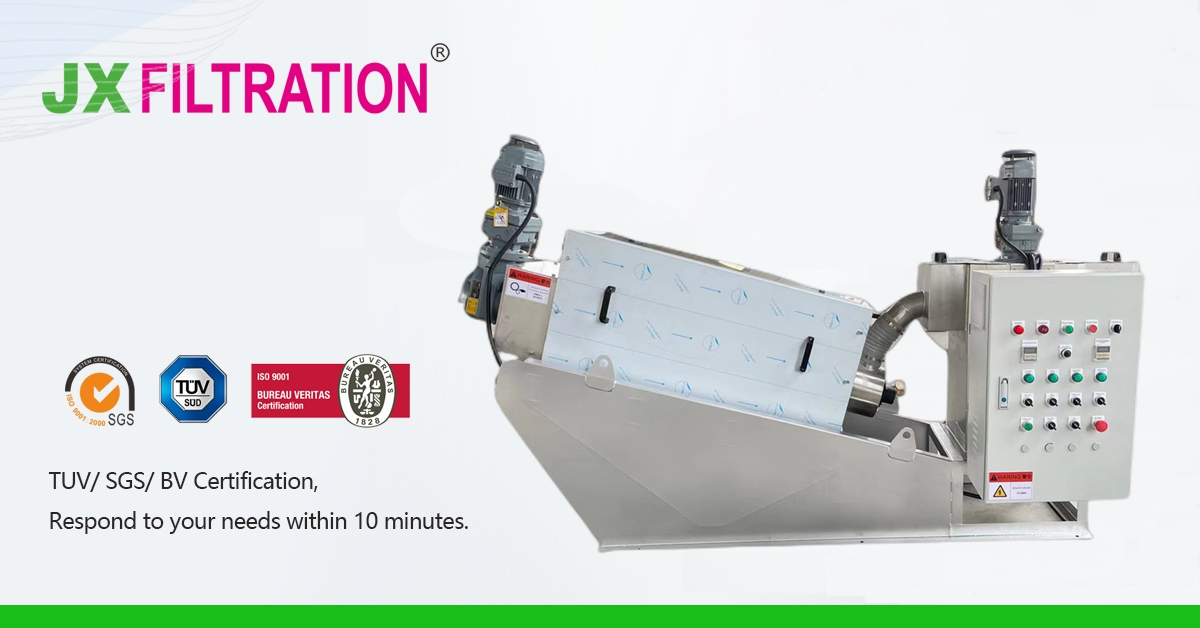
A Sludge Dewatering Screw Press is a highly efficient dewatering device that combines the principles of screw extrusion and dynamic-static ring filter slots. Its advantages are particularly prominent in the treatment of organic sludge. The main advantages of the screw press are as follows:
1. Continuous, fully automatic operation with extremely high efficiency
Unlike traditional intermittent plate and frame filter presses, the screw press can achieve continuous feeding, dewatering, and sludge discharge 24 hours a day. This greatly improves processing efficiency, reduces manual intervention, and is ideal for large-scale, continuous processing applications.
2. Energy and water saving with low operating costs
Its main motor power is typically very small (as low as 2.2kW or higher, depending on the model), and its energy consumption is far lower than that of centrifuges or belt filter presses with the same processing capacity. The screw press has a self-cleaning function. During the dewatering process, the relative movement between the dynamic and static rings generates shear force, automatically cleaning the sludge clogging the filter slots. This essentially eliminates the need for an additional high-pressure flushing water system, saving significant water resources and pump energy.
3. Corrosion Resistance and Long Service Life
The main components of the equipment (such as the screw shaft and rotating/stationary rings) are typically made of high-quality stainless steel (such as 304 or 316L), possessing excellent corrosion resistance. This effectively handles complex industrial wastewater sludge, extending the equipment's service life.
4. Strong Capacity for Processing Low-Concentration Sludge and High Adaptability
The screw press has relatively relaxed requirements for influent sludge concentration. Even sludge concentrations as low as 0.2%-0.3% can be processed directly without the need for a pre-thickening tank, unlike other equipment. This simplifies the process and enhances the system's adaptability.
5. High Solids Content in Sludge
By adjusting the back pressure plate and rotation speed, the screw press can typically dewater sludge to a solids content of 15%-25% (the specific value depends on the sludge properties), forming a sludge cake that is easy to transport and dispose of.
6. Simple Maintenance and Low Operating Costs
Because it operates at low speeds and lacks components that are prone to clogging or wear like filter cloth, the daily maintenance of a screw press is very simple. Only periodic checks of lubrication and bolt tightness are required, significantly reducing long-term maintenance costs and downtime.
In summary, screw presses are an ideal choice for those seeking high efficiency, energy saving, low operating costs, and automated operation.
Any requirements, contact us now!
Nina
Email: nina@filtrationchina.com
Mobile/Whatsapp/WeChat:+86 172 6957 1060