What's the Difference between Rotary and Linear Vibrating Screen?
Circular and linear vibrating screens are two types of screening equipment based on different vibration principles and working methods, therefore they differ significantly in structure, working principle, and application scenarios.
Working Principle:
- A circular vibrating screen uses a vertical vibrating motor to generate excitation force, causing a three-dimensional composite motion (vertical, horizontal, and inclined) on the screen surface. The material jumps forward in a spiral motion on the screen surface.
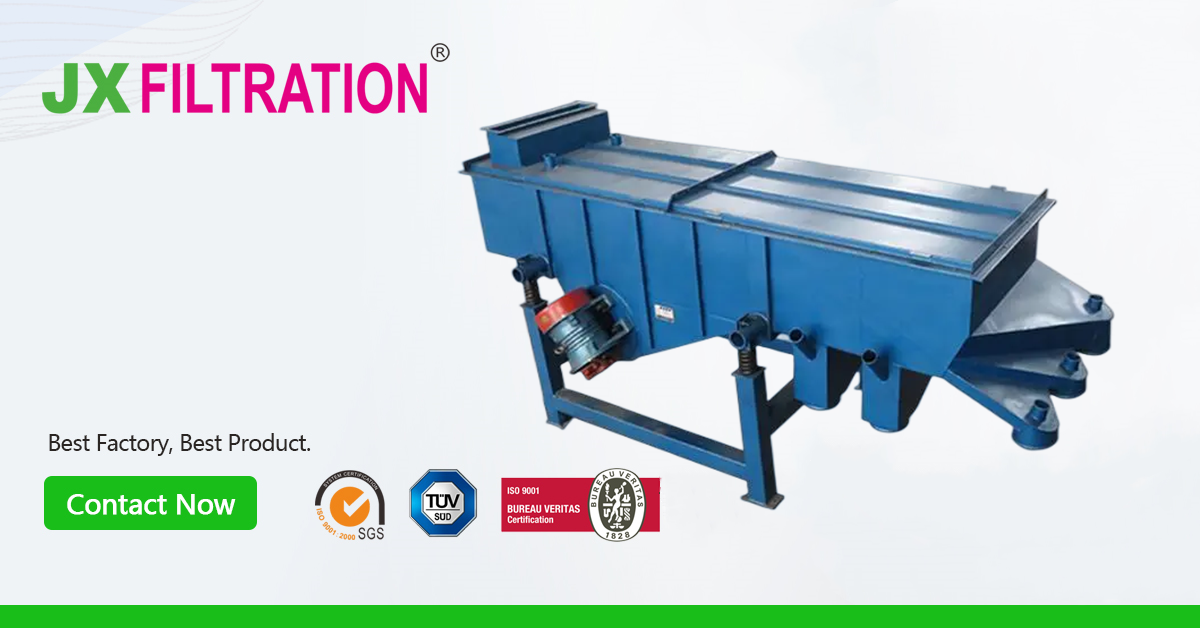
- A linear vibrating screen uses two horizontally mounted vibrating motors that rotate synchronously in opposite directions, generating a single linear forward throwing force. The material is thrown horizontally on the screen surface, moving in a straight line.
Main Functions:
- Circular vibrating screens are mainly used to accurately separate materials into two or more specifications (such as mesh size) according to particle size, suitable for separating oversize (residue) and undersize (filtrate).
- Linear vibrating screens are mainly used to remove moisture (dehydration), wash media (de-sizing), or remove small amounts of large particle impurities from materials.
Structural Features:
- Circular vibrating screens typically consist of a single or multiple layers of screens vertically stacked within the same vibrating body, resulting in a compact structure and small footprint.
- Linear vibrating screens have a single-layer, elongated screen box, which is relatively simple in structure but long and occupies a large area.
Applicable Materials:
- Circular vibrating screens are suitable for dry, lightweight, sticky, or irregularly shaped granular materials, such as flour, starch, chemical powders, metal powders, and plastic granules.
- Linear vibrating screens are suitable for moist, heavy, and lumpy materials, such as ores, coal, quartz sand, and waste residue.

Circular vibrating screens act as "quality inspectors," prioritizing precision and accuracy, and are suitable for applications with strict requirements on product particle size. Linear vibrating screens act as "processors," prioritizing efficiency and output, and are suitable for coarse screening and dewatering applications with large throughput and less stringent precision requirements.

Any requirements, contact us now!
Nina
Email: nina@filtrationchina.com
Mobile/Whatsapp/WeChat:+86 172 6957 1060